Pick up any serious tin of olive oil and somewhere on the label you will find the words cold pressed or cold extracted. It is the most repeated claim in the entire category — and the least explained.
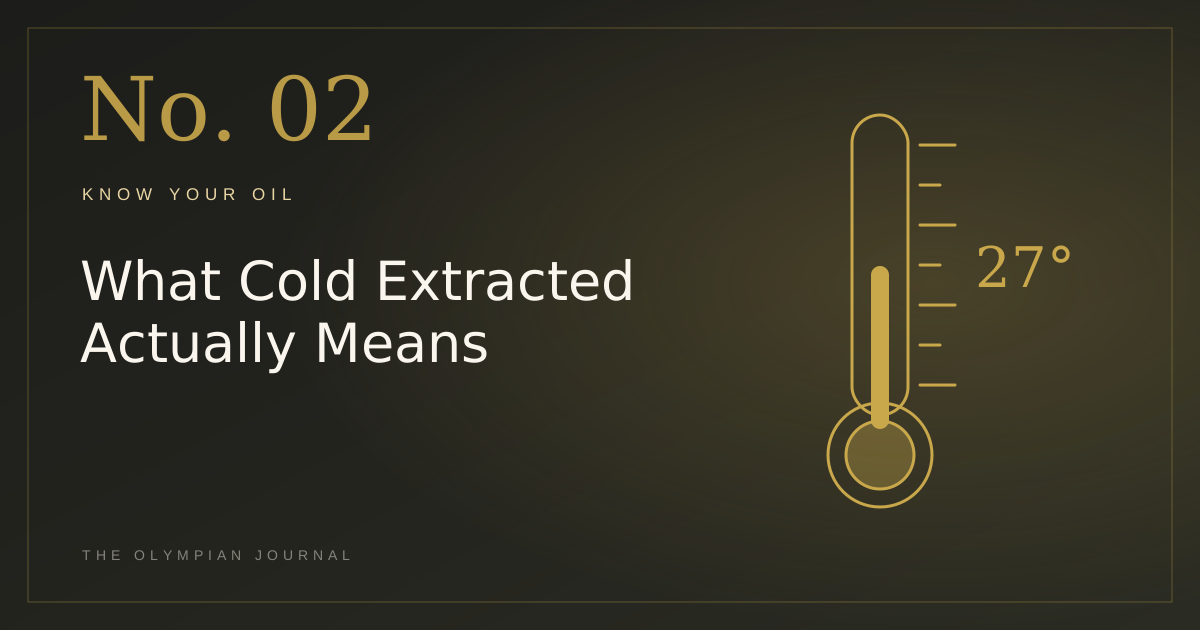
It is not marketing poetry. It is a specific, measurable rule with a number attached to it, and that number is the whole story: 27 degrees Celsius.
Here is what actually happens to an olive between the tree and your tin, and why temperature decides more about the oil than almost anything else.
Malaxation: the quiet half hour that makes the oil
After the olives are crushed — pits and all — you do not have oil yet. You have a paste. To get the oil out, that paste is stirred slowly, usually for twenty to forty-five minutes, in a stage called malaxation. Tiny droplets of oil find each other and merge into drops large enough to separate.
Here is the catch. Warm the paste and the oil flows more freely — the mill gets more oil out of the same olives. But heat does two other things at the same time: it drives off the volatile aromas that make fresh oil smell like cut grass and green almond, and it begins to break down the polyphenols, the antioxidant compounds behind both the peppery bite and the health benefits.
Every degree is a trade: more oil, less of what makes the oil worth having. Cold extraction is the decision to lose that trade on purpose — to accept a smaller yield in exchange for everything the heat would have taken.
The 27-Degree Rule
The phrase is regulated, at least where regulation has teeth. Under European Union rules, a producer may only print cold extracted or cold pressed on an extra virgin or virgin olive oil if the paste never exceeded 27°C — about 80°F — during malaxation and extraction.
Twenty-seven degrees is not cold in any kitchen sense. It is a mild summer morning. The word cold does not mean refrigerated. It means never warmed beyond what the grove itself would feel in the shade. The paste is kept at the temperature of the harvest, not the temperature of the machine.
That ceiling is the entire claim. When we say our oil is cold extracted, we are saying the olives were crushed, stirred, and separated without ever crossing 27°C — from the tree to the tin, nothing was added and nothing was cooked out.
Why There Is No Press Anymore
One more honesty note, because the label language has not caught up with the machinery.
For centuries, olive oil really was pressed — paste spread on mats, stacked, and squeezed under enormous stone or screw presses. First pressing meant the gentlest squeeze: the best oil, taken before heat and pressure were applied to extract the rest.
Almost nobody makes oil that way now. Modern mills use centrifugal decanters — the paste spins, and oil separates from water and solids by density. It is faster, cleaner, and gentler on the oil than any press ever was. And because the whole batch passes through once, there is no second pressing to speak of. Effectively all extra virgin olive oil today is, in the old language, first press.
So when a label says first cold press, it is telling you something true about quality using words from a machine that retired decades ago. Cold extracted is the accurate modern term — extraction done cool, once, with nothing held back and nothing forced.
Cold extraction is the decision to accept a smaller yield in exchange for everything the heat would have taken.
What You Are Actually Tasting
Take the lid off a tin of fresh, cold-extracted oil and the smell rises before you even pour — green, grassy, a little bitter at the edges, like crushing an olive leaf between your fingers. That is not romance. That is chemistry that survived.
The aroma comes from volatile compounds that evaporate readily — which is exactly why heat destroys them in the mill and why they are still there when the mill stays cool. The peppery catch at the back of your throat comes from a polyphenol called oleocanthal, which survives malaxation intact at 27°C and diminishes as temperatures climb.
A warm-extracted oil is not spoiled, and it is not fake. It is simply quieter — less aroma, less pepper, fewer of the compounds you bought it for. The mill got more oil. You got less olive.
27°C — the maximum paste temperature allowed for an oil to carry the words cold extracted or cold pressed under EU rules.
20–45 minutes — the typical malaxation time, the slow stirring that lets droplets of oil merge before separation.
Hours, not days — how quickly olives should reach the mill after picking. Temperature control means nothing if the fruit sat fermenting in a crate first.
One pass — modern centrifugal extraction means there is no second pressing. All genuine extra virgin is, in the old terms, first press.
How to Read It on a Label
The accurate modern term. Extraction below 27°C, by centrifuge. This is the phrase to look for.
The same claim in older language. Held to the same 27°C rule where it is enforced.
No temperature claim, no harvest date, no mill. The label's silence is also information.
Pair the phrase with the other signals we keep coming back to in this series: a harvest date, a named region, a variety you can look up. Cold extracted is a promise about one night in November at the mill. The rest of the label tells you whether the people making that promise are the kind who keep them.
And when you get the oil home, keep the promise going — the compounds that cool milling preserved are the same ones heat and light destroy in your kitchen. The mill did its part. The cupboard above the stove is yours.
Cold Extracted, Picked in November
100% Koroneiki from the Peloponnese, pressed within hours of harvest and never warmed past 27°C. Three and five litre tins.
Sources: EU marketing standards for olive oil labeling (the 27°C ceiling for "cold extracted"/"cold pressed" claims); UC Davis Olive Center publications on extraction temperature, yield, and quality.