Stand at the back door of a busy restaurant kitchen and you will rarely see one bottle of olive oil. You will see two or three, each with its own job. The expensive one, the one you can taste, is usually the one used least.
That is not penny-pinching. It is how professional cooks get the most out of every oil they buy, and it is a system that works just as well at home.
Heat With One, Taste With the Other
Ask a line cook which oil goes in the pan and which goes on the plate and you will usually get the same answer: cook with something steady, finish with something good.
The reasoning is simple. A good extra virgin olive oil is all about flavour: grass, green tomato, artichoke, that peppery catch at the back of the throat. Much of that flavour is delicate. Simmer it for two hours in a braise, or spread it thin across a hot flat-top all night, and a lot of what you paid for fades. The same oil spooned raw over the finished plate is the first thing a guest tastes.
So kitchens split the work. A steady, mild oil does the heavy lifting at the stove, and the extra virgin goes on at the end, where its flavour survives.
The expensive oil is the one used least, and that is exactly where it shows.
What “Refined” Actually Means
The workhorse oil in many kitchens is refined olive oil, or a blend built on it. The word puts people off, so it is worth being plain about what it is.
Extra virgin olive oil is the juice of the olive, separated by mechanical means only and held to strict limits on acidity and taste. When oil from the mill does not meet those standards, it can be refined: filtered, and steamed under a vacuum, which takes out the strong flavours, the colour and most of the natural compounds. Some refineries first use a food-grade alkali wash to remove free fatty acids. No chemical solvents are used to make refined olive oil; solvents belong to pomace oil, which is made from the leftover pulp and pits and is a different product.
What comes out is mild, pale and steady. It loses most of what makes extra virgin special, including most of its polyphenols, and it gains a clean neutrality that lets other ingredients lead.
Extra virgin olive oil: the top grade. Mechanically extracted, low acidity, no taste defects.
Virgin olive oil: also unrefined, with slightly higher acidity or small flavour faults.
Olive oil: a blend of refined olive oil with some virgin oil added for flavour. Sometimes sold as “pure” or “light.”
Refined olive oil: refined only, with no virgin oil added.
Olive-pomace oil: extracted from the leftover pulp and pits, usually with solvents. A separate category.
A word on “light”
“Light” olive oil is light in colour and flavour, not in calories. Every olive oil, extra virgin or refined, has about the same calories per spoonful. The word describes the taste.
Is Refined Olive Oil Bad?
No. It is a different tool. The problem in the olive oil aisle has never been refined oil itself. It is refined oil sold as something it is not: blends quietly labelled extra virgin, and “imported from Italy” stamped on oil that only passed through. That is what has made the whole category hard to trust.
A refined oil that says what it is on the label is honest. Use it for what it is good at, and buy your extra virgin for what only extra virgin can do.
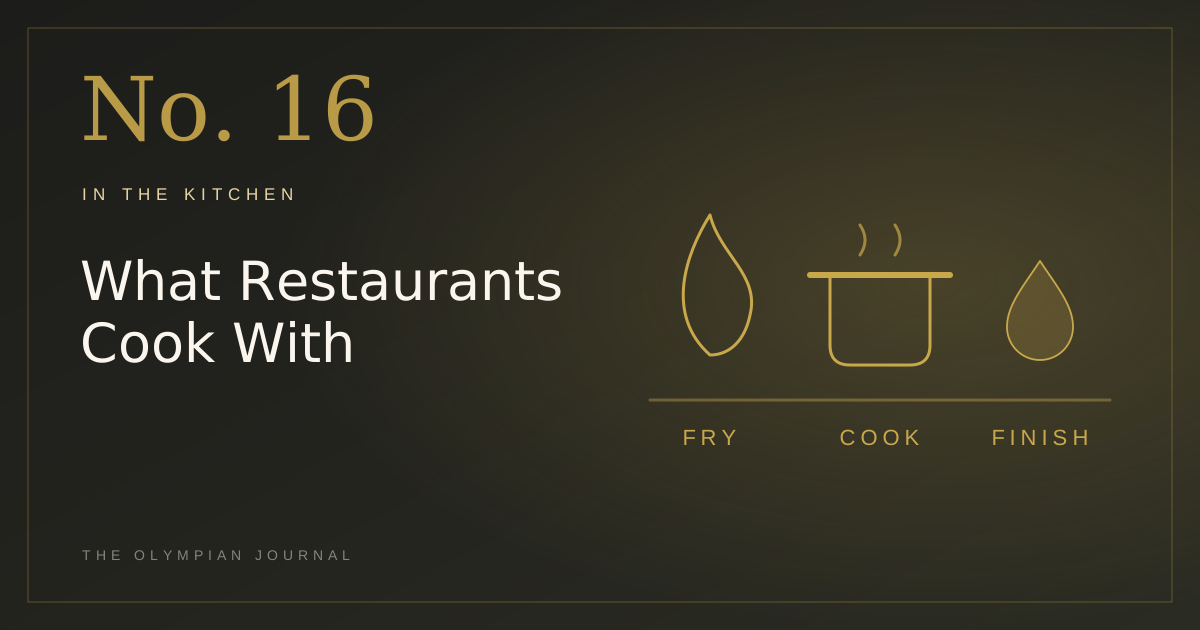
Three Oils, Three Jobs
Here is the system most professional kitchens land on, scaled down for a home kitchen.
A high-heat frying oil for the deep pot: neutral, stable, and kind to a fryer that runs for hours.
A mild everyday oil for sautéing, roasting, braising, baking and marinades. The bottle by the stove.
A good extra virgin for salads, dipping and the last spoonful over a finished dish. The one you taste.
You do not need all three to cook well. But if you cook every day, a steady everyday oil means you stop rationing the good bottle, and you start pouring the extra virgin where it counts.
Where a Mild Oil Wins
Long, slow cooking
Braises, soups, beans baked in the oven for hours. Long heat mutes delicate flavour, so cook with the steady oil and swirl a little extra virgin over each bowl at the table.
Baking
Some bakes want the fruit and pepper of extra virgin; an olive oil cake is one of them. Others want the oil in the background. Many bakers making melomakarona, the honey and orange cookies of a Greek Christmas, prefer a mild oil so the spice and honey come through.
Marinades and roasting
A mild oil carries garlic, herbs and spices without competing with them, and it coats vegetables evenly for the oven.
Eggs and the flat-top
Restaurants cook eggs by the hundred on a hot griddle. A mild oil gives clean, non-stick results and lets the eggs taste of eggs.
Heritage: the restaurant oil, now for home
Heritage is the everyday cooking oil we have sold for years by the case to restaurant kitchens. It is a refined olive oil blend: mild, steady, and made for sautéing, roasting, baking and marinades. It is not extra virgin, and it is not meant to be.
It now comes in a single 3-litre bottle for home cooks. Cook with Heritage, fry with Kouzina, and keep the extra virgin for the plate.
How to Tell at the Store
Read the grade on the front of the label, not the adjectives around it. “Extra virgin” is a grade. “Pure,” “light,” “classic” and “mild” are not; they usually mean a blend built on refined oil. That is fine, as long as it is what you meant to buy.
For the extra virgin, look for a harvest date, not just a best-by date, and a dark bottle or a tin. For the everyday oil, look for a size that makes sense for how much you cook. Buying it by the litre is the point.
Heritage Olive Oil, 3 Litres
The everyday cooking oil restaurant kitchens use, now in a single bottle. $36.99, shipping $14.99 per order.
Grade definitions follow the US Standards for Grades of Olive Oil and Olive-Pomace Oil. Heritage is a refined olive oil blend, not extra virgin.